All-in-One Solar Street Light
Fast installation for repeatable road and community programs.
View product family →
ROADS & INFRASTRUCTURE
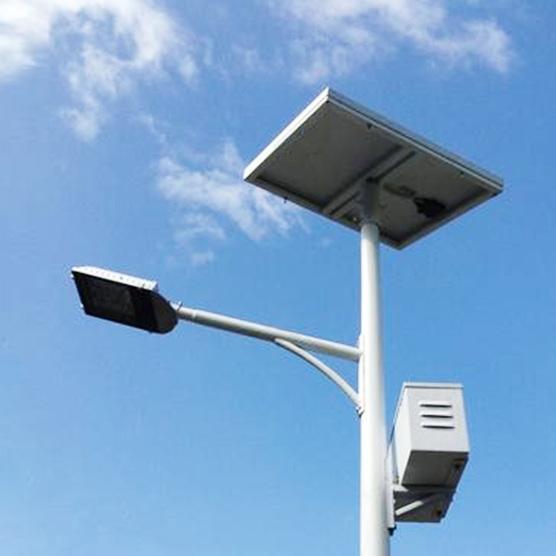
Answer first: Municipal solar street lighting should be specified as a complete energy and optical system—not by lamp wattage alone. Road geometry, target illuminance, local solar resource, operating hours and backup-night requirements determine the right luminaire, panel, battery, controller and pole layout.
BEST-FIT PRODUCT FAMILIES
Fast installation for repeatable road and community programs.
View product family →Independent panel orientation with a coordinated semi-integrated assembly.
View product family →Flexible energy capacity and component access for demanding infrastructure.
View product family →DESIGN PRIORITIES
These inputs control optics, energy sizing, mounting and lifecycle decisions.
PROJECT WORKFLOW
Document the road geometry, lighting target and project constraints.
Check the proposed optics, pole layout and surface illumination photometrically.
Match panel and battery capacity to local solar resource and operating profile.
Confirm samples, controls, documentation, packaging and spare-parts strategy.
BUYER QUESTIONS
Provide the project location, road width, pole height and spacing, mounting arrangement, target lux or applicable standard, operating hours, backup nights and quantity.
All-in-one, all-in-two and split systems can all work. The best architecture depends on output, solar orientation, installation resources, capacity and maintenance strategy.
It is the correct way to check illumination and uniformity before a volume project. Nominal lumens or watts cannot verify the road layout by themselves.
The energy system is sized around local solar resource, agreed autonomy and a control profile that may reduce output during prolonged low-charge conditions.
PROJECT REVIEW
Reluxlight can review the application, recommend a product architecture and identify the data required for energy and photometric validation.