
KEY TAKEAWAY
What this means for solar-lighting buyers and project teams.
NASA's July 2026 Earth Observatory feature confirms that the Green River Energy Center in Utah combines 400 MW of solar generation with 400 MW of battery storage. For public-infrastructure and off-grid buyers, the important lesson is not the headline size: it is the need to define the required service, grid connection and operating evidence before choosing a battery or solar configuration.
What NASA documented
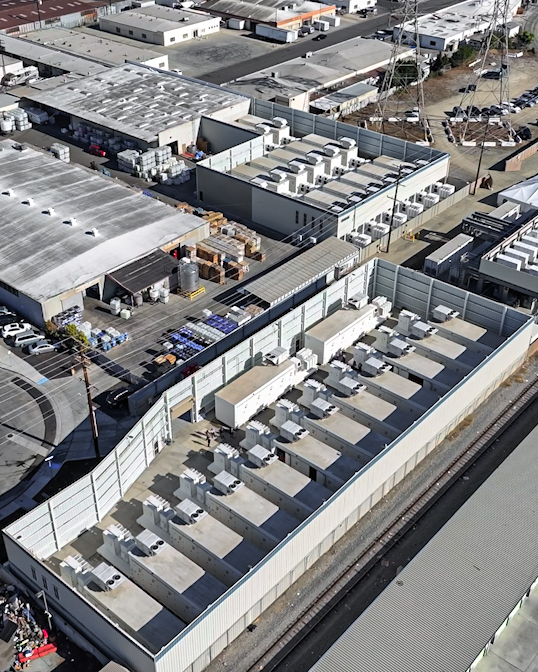
NASA says the Green River Energy Center came online in June 2026 near Green River, Utah. Its Earth Observatory article describes nearly one million photovoltaic panels, 400 MW of solar generation and 400 MW of battery storage. NASA also reports roughly 500 battery units and notes that the project can use transmission lines originally built for coal generation.
This is an operational-scale example of combining generation, storage and existing network infrastructure. It should not be read as proof that every 400 MW battery has the same duration, dispatch capability or economics. Power in megawatts is different from usable stored energy, and each project needs its own duty cycle, losses, temperature range and grid constraints defined.
Why existing infrastructure deserves early review
Repurposing transmission can shorten the path to useful clean-energy capacity, but it does not remove interconnection analysis. Owners still need to establish export limits, protection settings, metering boundaries, communications, curtailment rules and responsibility for upgrades. Those items influence the usable value of solar and storage just as directly as panel or battery selection.
The same principle applies at a smaller scale. A solar-lighting programme may avoid a new grid connection, yet it still depends on a documented energy balance: lighting load, operating schedule, local irradiance, shading, battery operating window, controller losses and maintenance assumptions. A nameplate battery figure alone cannot demonstrate night-time service.
Buyer impact: specify delivered service
For a solar-plus-storage tender, ask bidders to state the guaranteed delivered power, usable energy, duration at the defined duty cycle, auxiliary consumption, availability boundary and control modes. Require the single-line diagram, battery safety documentation, commissioning plan and performance-test method to be tied to the offered configuration.
For autonomous public lighting, translate the same discipline into measurable acceptance criteria: required illuminance and uniformity, nightly operating profile, days of autonomy, dimming behaviour, fault reporting and replacement responsibilities. NASA's project is a useful scale reference; the purchasing decision should still rest on verifiable performance at the actual site.
FREQUENTLY ASKED QUESTIONS
Questions this industry update may raise
Does 400 MW of battery storage state the storage duration?
No. MW states power. Usable energy and duration must be specified separately.
Can reused transmission remove all grid risk?
No. Interconnection, protection, metering and operating limits still need project-specific review.
What should an off-grid lighting buyer verify?
Verify the location-specific energy balance, lighting performance, autonomy, controls and service plan.
SOURCES